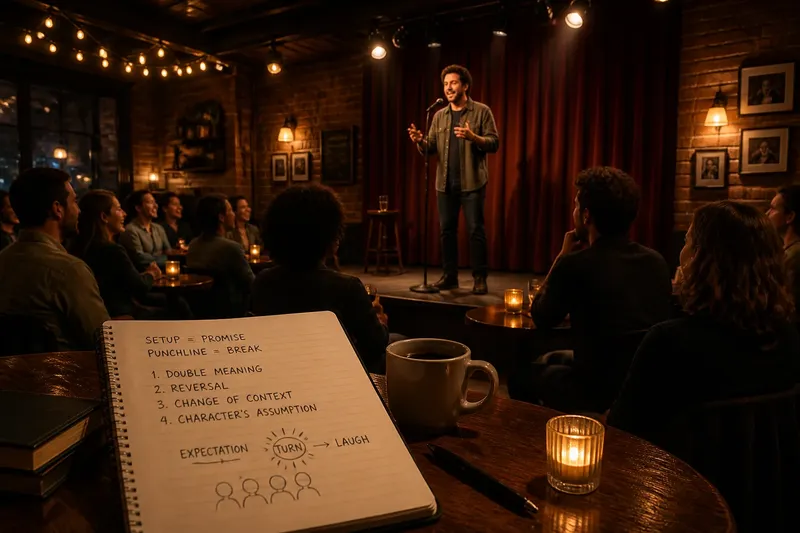
Why a Pause Can Make a Punchline Smaller
Why a pause can make a punchline smaller: learn when to mark silence, when to leave it open and how to give performers a playable reason to wait.
An actor reaches the end of a line, sees “(beat)” and waits. The silence may sharpen the joke, but it may also make the audience brace for a punchline before the words arrive. Why a pause can make a punchline smaller comes down to what the silence tells the audience to expect.
A marked pause can announce the joke too early
A pause can shrink a punchline when it signals that a laugh is due. The audience starts watching for the joke instead of following the character’s thought. When the line finally arrives, it may feel less surprising than it would have without the warning.
That effect is not automatic. Silence can give a reaction room, show a change of mind or let an awkward moment remain awkward. The useful question is whether the pause belongs to the character or has been added to advertise the laugh.
A character might stop because they are searching for a word, waiting for an answer or reluctant to say something plainly. Each silence has a different cause, even if the script marks them all with the same word.
Read the line aloud without the mark. If the exchange still makes sense and the actor can find a natural breath, the notation may be signalling more than the scene needs.
Give the silence a playable cause
A direction is most useful when it tells the performer what changes, rather than simply how long to wait. A character who tries to look composed after an awkward remark has something to do: recover without admitting embarrassment. That intention might show through a glance, a breath or the careful movement of an object.
Compare “(pause for laugh)” with “She looks to him; he keeps sorting the papers.” The first asks the performer to wait for a response that varies with the room. The second gives both actors a visible action to play, without predicting the length of the audience’s reaction.
“A beat” can be a flexible cue for a brief interval or a shift in the exchange, but it does not name the character’s reason. Use it when that general cue is enough. If the silence carries a specific thought, action or relationship, write that instead.
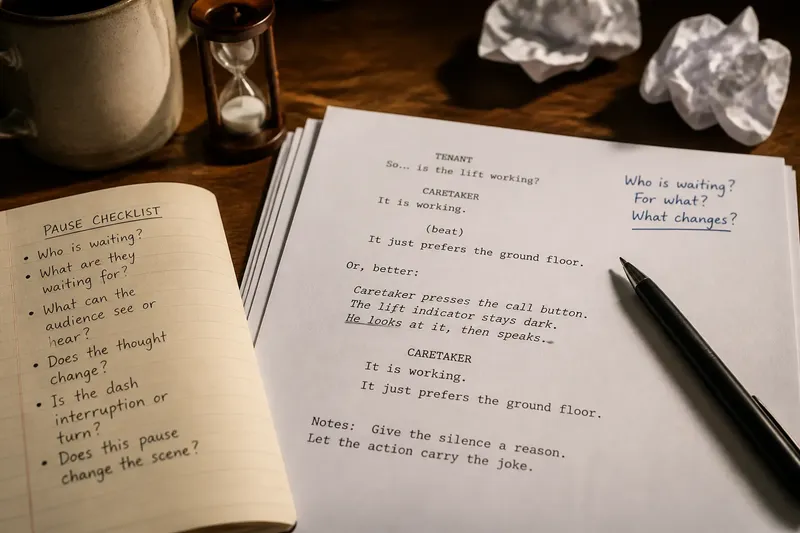
Name who is waiting and what they are waiting for.
Choose punctuation for the speech it suggests
A dash suits speech that breaks off, is interrupted or changes direction. It can mislead if used for a neutral silence, because a performer may read it as a sudden turn rather than a wait.
An ellipsis can suggest a thought that trails away or remains unfinished. It does not reliably specify a silent pause; if a character stops speaking to listen, a short direction outside the dialogue is clearer.
No mark may be needed when the words already contain the timing. A question followed by an answer does not automatically need a “beat” simply because the actor should let the question register. Rehearsal can reveal whether a direction would prevent confusion or merely underline the joke.
Say you are writing an invented scene in which a tenant asks a caretaker whether the lift is working. The caretaker says, “It is working. It just prefers the ground floor.” With “(beat)” before the answer, the actor may deliver it as an announced joke. If the caretaker instead presses the call button, sees no response and answers while looking at it, the action supplies the comic context; the line can arrive without a signposted wait.
Keep the performer’s timing choice intact
A script can establish the circumstance and leave the actor to decide how the body responds. Mark a silence when it prevents a misunderstanding, changes who has control of an exchange or directs attention to something the audience might otherwise miss. Avoid prescribing an expressive detail that can be found in rehearsal.
This is not a reason to remove all stage directions. A direction can clarify who notices a sound, who refuses to answer or what makes a thought difficult to say. The distinction is between recording an event the scene depends on and dictating a pause simply because a joke follows.
Read the scene aloud with different plausible timings. If the meaning remains clear, the script can leave the length open. If a particular silence changes what the audience understands, give the performer a reason for it.
In a scene with several performers, identify whose silence matters. The listener may be waiting, while the speaker is ready to continue. Naming that relation helps the actors respond to one another instead of treating each pause as an isolated cue.
- Check whether the audience must see or hear an event during the silence; if so, name it in the direction, and otherwise consider leaving the pause unmarked.
- Check whether a character is waiting for another person to answer; if so, identify who is waiting, and otherwise remove a cue that implies a response.
- Check whether the character’s thought changes during the pause; if so, describe the change, and otherwise let the actor find a natural breath.
- Check whether a dash represents interrupted or redirected speech; if so, keep it, and otherwise use a clearer action or no mark.
- Check whether an ellipsis means the thought trails off; if so, keep it, and otherwise avoid using it to imply a neutral silence.
- Check whether a “beat” prevents a likely misunderstanding; if so, retain the flexible cue, and otherwise remove it and read the exchange aloud.
Which questions about comic pauses come up most often?
Does “beat” mean a fixed amount of time?
No. It is a flexible cue for a brief interval or shift, not a standard count. Its length depends on the action and the exchange.
Should every pause before a punchline be marked?
No. Mark a silence when it changes the scene or prevents confusion. If the wording and performance already make the timing clear, the cue may make the audience anticipate the joke.
Can an ellipsis or dash replace a pause direction?
Sometimes, but each suggests a different speech pattern. An ellipsis can imply a trailing thought, while a dash often signals interruption or a turn.
What can an actor do if a printed pause feels too long?
Look for the action or thought behind the mark rather than treating it as a count. If its purpose remains unclear in rehearsal, the writer and performers can revise the direction together.
Keep only pauses that change the scene
During revision, ask of each silence: who is waiting, what are they waiting for, and what can the audience observe? If the answers reveal no character action and no change in attention, the direction may be an unnecessary signal.
The practical distinction is between a pause that belongs to the character and one that announces the joke. For a script about why a pause can make a punchline smaller, the useful rule is to give the performer a reason to wait and leave the audience room to notice what the silence changes.